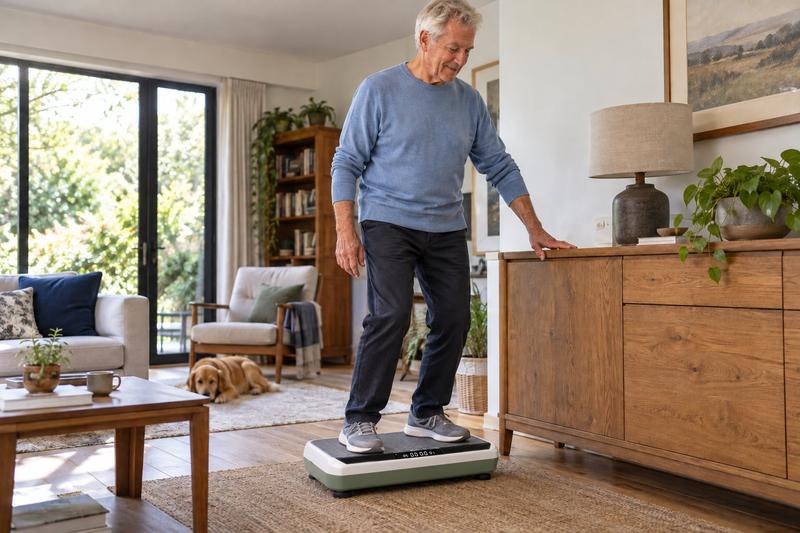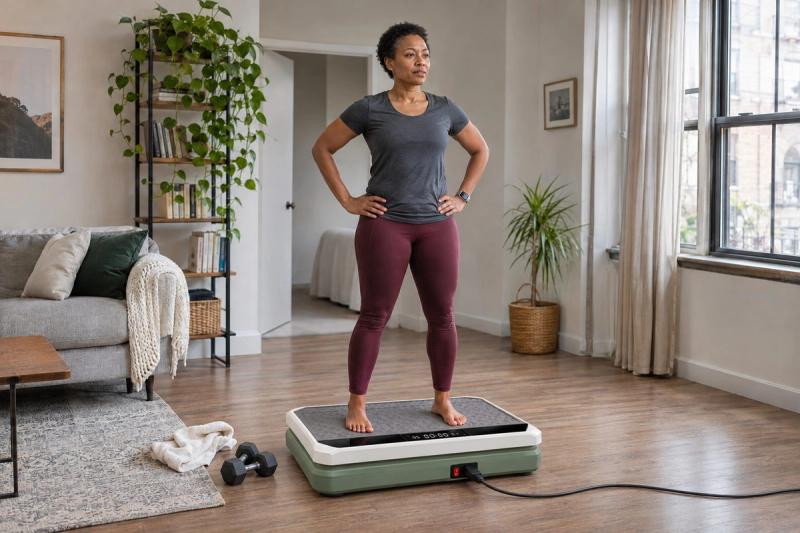
Vibration plate before or after workout? Use it after if sore legs are what you want to ease, because that timing has more research behind it. Before a workout, a plate works like a normal warm-up. One large trial found the vibration added nothing on top.
Should you use a vibration plate before or after a workout?
After a workout has more support. Two reviews of randomized trials found that vibration lowered muscle soreness in the days after hard exercise. Most of those trials used vibration after the workout.
Before a workout, the evidence looks different. A plate session can be part of a warm-up, but the warm-up trials found no extra boost to jumping or running from the vibration itself. One trial in trained men measured something else, soreness after a plate warm-up, and those men felt less sore.
No trial we found compared before and after directly in the same people on a plate. So the answer comes from separate studies, and each one tested a different question.
Does a vibration plate work as a warm-up?
It works about as well as the same warm-up without vibration. The largest trial tested this in 93 healthy, active young adults (Amato et al., 2025). The researchers split them at random into three groups.
One group warmed up for 5 minutes on a vibrating plate. A second group did the same 5-minute warm-up on the plate with the vibration switched off. A third group just rested.
Both warm-up groups jumped higher afterward, and the resting group declined. The vibration group did not jump any higher than the group with the plate switched off. So the warm-up helped, and the vibration added nothing extra.
A smaller study tested 12 active men (Ewertowska et al., 2023). Each man tried four different warm-ups, in random order.
Two of them were calf raises on a plate, once with the vibration off and once with it on. The third was drop jumps, and the fourth was the vibrating calf raises followed by drop jumps. Compared with calf raises with the vibration off, none of the others improved their jump or their time on a 3 km run. The authors thought the warm-up may have been too short to make a difference.
So a vibration plate warm-up is fine if you enjoy it. Just don't count on it to boost your performance.
Does a vibration plate help with soreness after a workout?

Probably, for the sore legs that show up a day or two after a hard session. Researchers call this delayed-onset muscle soreness. It usually follows exercise your muscles are not used to, especially lowering moves like the way down in a squat (Yin et al., 2022).
A 2019 review combined 10 randomized trials (Lu et al., 2019). Together they included 258 people who had done hard, unfamiliar exercise.
Vibration lowered soreness scores the day after hard exercise. The scores stayed lower on the second and third days too. Most of the trials gave the vibration after the workout. Six of the trials used vibration plates. The other four used small devices placed on the muscle. A blood marker of muscle damage, called creatine kinase, was also lower for the first two days. By the third day, it was no different.
The authors also checked whether the kind of vibration mattered, or whether it came before or after exercise. The type of vibration did not change the result, and neither did the timing. Still, the overall result mixes plates with handheld devices, which limits what it says about plates alone.
A 2022 review came to a similar answer. Vibration training eased pain and raised people's pain tolerance. The clearest drop in pain came after 48 hours. Its effect on how far people could move their joints was unclear.
These reviews measured soreness on a pain scale. They did not test whether people trained harder or got fitter the next week.
Can a vibration plate before lifting reduce soreness?
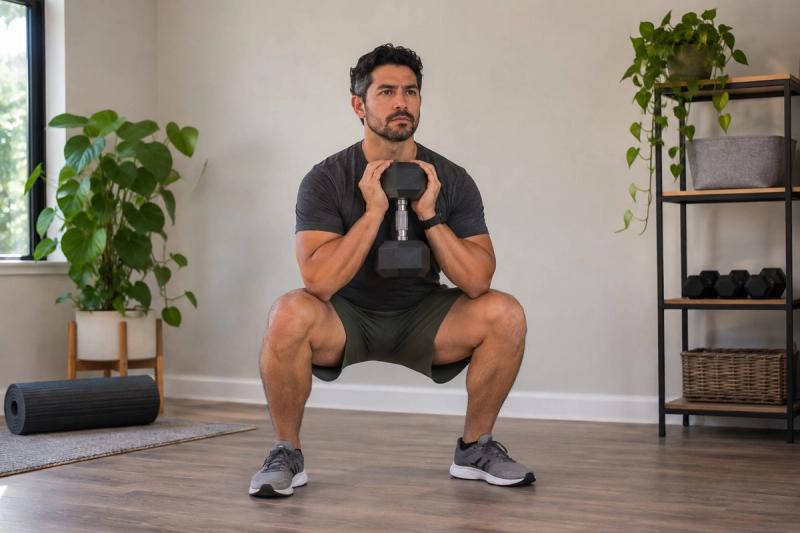
One trial suggests it can, a little. It included 30 men who already lifted weights (Magoffin et al., 2020). All of them did 300 hard lowering movements with their thigh muscles, the kind of work that usually leaves legs sore.
One group warmed up on a vibrating plate first, and the other group warmed up without it. The vibration group reported less soreness a day later. They also reported less soreness two days later. Both groups lost about the same amount of strength. Their sensitivity to pressure on the sore muscle was also the same.
The authors called the effect mild. It is also one trial in young, trained men, so it may not apply to everyone.
How do you fit a vibration plate into a workout?
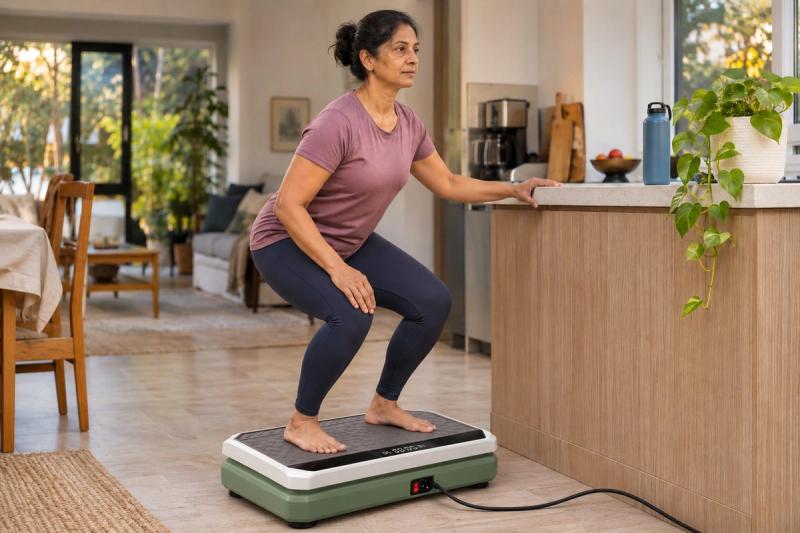
Put your main plate session at the end if soreness is what you care about. A few minutes of slow squats or calf raises on the plate is a simple way to finish. Our guide to how to use a vibration plate covers settings, soft knees and how long each bout should last.
Before a workout, treat the plate as one part of your warm-up. Follow it with the moves you are about to train, such as lighter squats before a leg day. For a full plate routine, try these vibration plate exercises.
If you lift heavy and often feel sore the next day, you could use the plate both before and after. That combination is your own experiment, so see how your legs feel the next morning.
We'd start with a few minutes on the plate right after your next leg day.
Short, regular sessions are also the idea behind our board. Kiwii Move is an interactive whole-body vibration board — a vibration plate with four pressure sensors that turns 10 minutes a day into games you play with your body. You can read more about our interactive vibration board.
Sources
Amato A et al., Frontiers in Physiology. Whole-body vibration as an effective sports competition warm-up: a randomized controlled trial in a young and healthy population. 2025. pmc.ncbi.nlm.nih.gov
Ewertowska P et al., Scientific Reports. Effects of whole-body vibration warm-up on subsequent jumping and running performance. 2023. pmc.ncbi.nlm.nih.gov
Lu X et al., Journal of International Medical Research. Does vibration benefit delayed-onset muscle soreness?: a meta-analysis and systematic review. 2019. pmc.ncbi.nlm.nih.gov
Yin Y et al., Medicine. The effect of vibration training on delayed muscle soreness: A meta-analysis. 2022. pmc.ncbi.nlm.nih.gov
Magoffin RD et al., Journal of Strength and Conditioning Research. Whole-Body Vibration as a Warm-up Before Exercise-Induced Muscle Damage on Symptoms of Delayed-Onset Muscle Soreness in Trained Subjects. 2020. europepmc.org